
Attacks on Healthcare: Medical Staff Deserve More Than Empty Words
In 1 click, help us spread this information :
Luxembourg, April 30th, 2026.- The 3 May will mark 10 years since the United Nations Security Council unanimously adopted Resolution 2286. Over 80 Member States committed to protect medical and medical humanitarian personnel, infrastructure, transport and equipment.
Today, international medical humanitarian organisation Médecins Sans Frontières (MSF) calls on States to respect this commitment, and protect medical care.
MSF has teams working in over 70 countries around the world, including in the Occupied Palestinian Territory, Lebanon, Ukraine, Sudan and Myanmar, as well as other areas of conflict and war.
In the last decade, 21 MSF staff have been killed in 15 incidents whilst undertaking their duties.
In 2025 alone, the World Health Organization’s Surveillance System for Attacks on Health Care (SSA) reported a total of 1,348 attacks on medical facilities, resulting in the deaths of 1,981 people.
What was once considered exceptional has now become commonplace”, said Dr Javid Abdelmoneim, MSF’s International President.
“We see a blatant disregard for the protection of the medical mission in countries at war. States who committed to protecting medical care back in 2016 must stop hiding behind excuses and finger-pointing, and act.”
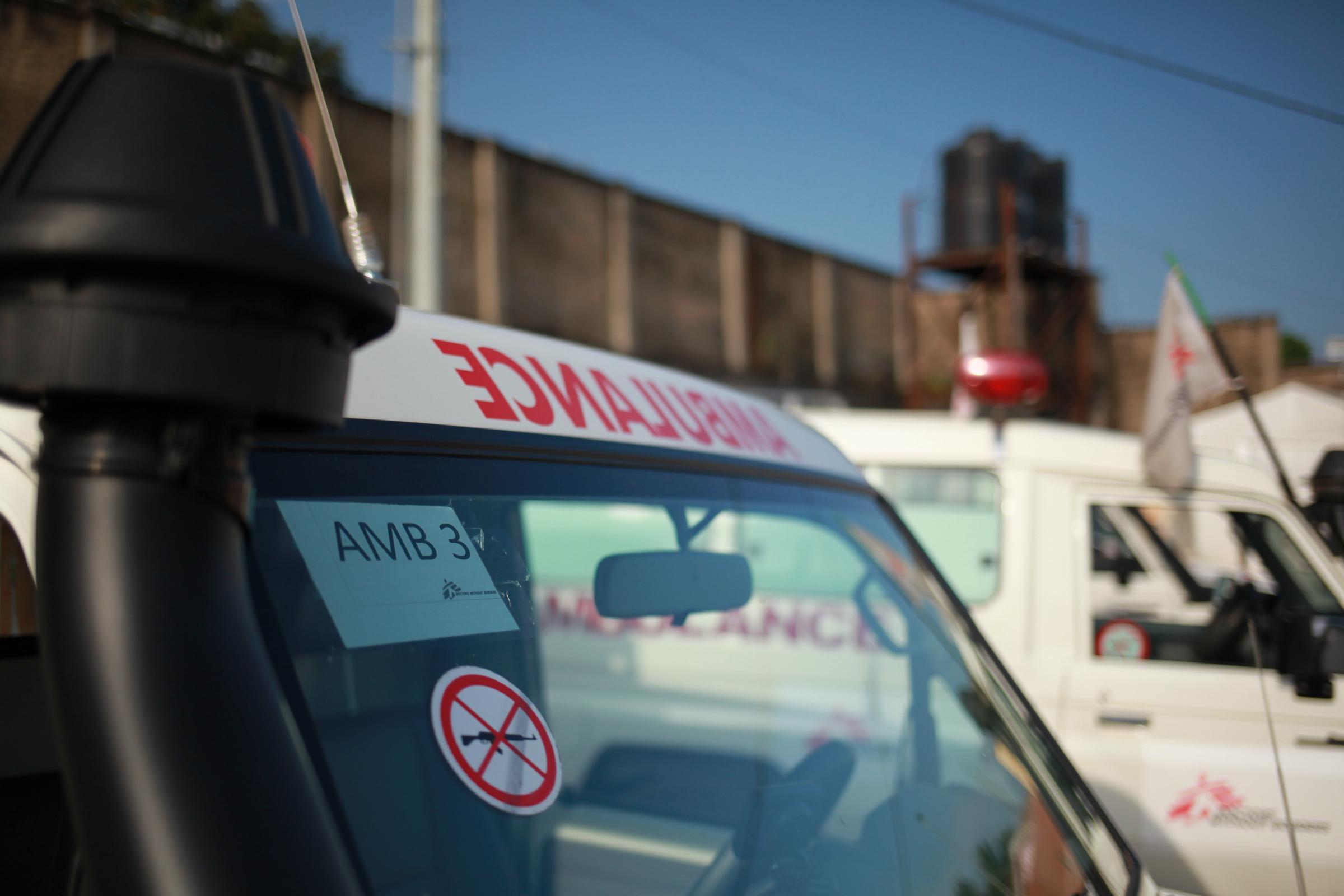
Over the last 10 years attacks on healthcare have been various and have included airstrikes on hospitals in Syria and Yemen, shellings of hospitals in Ukraine and the Occupied Palestinian Territory, drone strikes on a hospital in Myanmar, and attacks on clearly marked ambulances in Cameroon, Haiti and Lebanon. The response from perpetrating States has often been denial, to claim a mistake, or accusations of loss of protection without proof. Health workers are also increasingly being treated as suspect rather than protected.
The immediate consequence of attacks is injuries and loss of life. Longer-term, the consequence is that communities are often deprived of life-saving care as health infrastructure is not rebuilt or humanitarian organisations suspend their activities because of security concerns. In 2025, MSF teams in Sudan carried out nearly 850,000 outpatient consultations, admitted just under 95,600 people to hospital and assisted almost 29,000 births. In Gaza, over the same period, teams undertook 913,000 outpatient consultations, admitted just under 54,000 people and ran 89,800 mental health sessions. In Ukraine in 2025, MSF ambulances referred 10,700 patients, 60 per cent of whom had war-related injuries, and teams provided 45,300 outpatient consultations via mobile clinic, and undertook 9,750 physiotherapy sessions. When healthcare infrastructure is damaged or destroyed, and if people are too scared to leave their homes to seek medical care, it is the communities that suffer.
“Medical care in conflict is under extreme threat, as attacks against healthcare workers and functioning health infrastructure have been seen in almost every conflict over the past decade. MSF demands that States respect their obligations and commitment under Resolution 2286 for greater protection and accountability.
The protection granted to us and to our patients under International Humanitarian Law must be led by action, not just words.”
This week, MSF was forced to close its hospital in Lankien, South Sudan, following its bombing on 3 February, bringing 31 years of care to an end. Since the beginning of 2025, four hospitals have already been closed in this single country as a result of a series of attacks on health facilities, depriving hundreds of thousands of people of access to care.
Beyond the immediate human toll, these attacks have long-term consequences: entire communities are left without access to essential healthcare, due to the failure to rebuild health infrastructure or the suspension of humanitarian activities for security reasons.
Luxembourg urged to play a key political role in reversing the trend
Faced with the growing normalisation of attacks against health facilities and personnel, MSF calls on States to uphold their commitments, ensure independent investigations to identify those responsible for these attacks, and put an end to impunity, in line with the objectives set out ten years ago in Resolution 2286.
Regarding Luxembourg’s role, Paul Yon, Director General of MSF Luxembourg, states:
It is concerning that such attacks, in violation of international law, continue to go largely without consequences. The Luxembourg government must step up its efforts to implement Resolution 2286. The tenth anniversary should not remain a purely symbolic commemoration – concrete measures are urgently needed to deter and prevent further attacks. This requires Luxembourg to strongly reinforce international mechanisms for investigating and sanctioning violations. Any State aspiring to sit on the UN Security Council must consistently defend international humanitarian law, everywhere. There must be no complacency or double standards – neither in Ukraine, nor in Sudan, nor in Gaza, nor elsewhere.”
MSF works in more than 70 countries around the world, including Palestine, Lebanon, Ukraine, Sudan, and Myanmar, as well as in other conflict and war zones.
In 2025, MSF teams in Sudan carried out nearly 850,000 outpatient consultations, admitted around 95,600 people, and assisted nearly 29,000 deliveries. In Gaza over the same period, teams conducted 913,000 outpatient consultations, treated just under 54,000 people, and carried out 89,800 mental health sessions. In Ukraine in 2025, MSF ambulances transferred 10,700 patients, 60% of whom had war-related injuries, and teams provided 45,300 outpatient consultations through mobile clinics, as well as 9,750 physiotherapy sessions.