South Sudan

In 2025, South Sudan saw a sharp escalation in political tension, violence and insecurity, worsening an already severe situation marked by extremely limited access to healthcare and services.
Clashes between the government, opposition forces and non-state armed groups, particularly in Upper Nile, Jonglei, Unity, Central Equatoria and Warrap states, involved airstrikes and attacks on civilians on a scale not seen since the revitalised peace agreement was signed in 2018. This came at a time when international interest and support were already declining.
MSF has been working in the region since 1983, more than two decades before South Sudan gained independence in 2011, and the country remains one of the MSF's largest operations. Conflict, large-scale displacement, flooding and disease outbreaks all contribute to putting further strain on already stretched services. These emergencies are interconnected, driven and exacerbated by longstanding gaps in basic services, including healthcare and water, sanitation and hygiene (WASH) services.
Between January and June 2025, MSF treated over 700 patients with violence-related injuries across Jonglei and Upper Nile states. The injuries included gunshot wounds, knife wounds and burns from bombings.
In Upper Nile state, violent clashes between the South Sudan People’s Defence Forces (SSPDF) and Nuer militia began in February 2025 in Nasir, with a heavy aerial bombardment that resulted in numerous civilian casualties and the displacement of tens of thousands of people, both within the county and into Ethiopia. Between February and March, MSF teams treated over 200 war-wounded people across the border in Ethiopia.
By March 2025, most humanitarian organisations in Ulang, Nasir and Longechuk counties had suspended their activities; all health facilities along the Sobat Corridor from Doma to Mandeng were forced to close by April. While some health staff working in facilities supported by the Health Sector Transformation Project (HSTP) reportedly tried to relocate services into areas where people had been displaced, HSTP partners were unable to access these areas with medical supplies.
In Upper Nile state, it was not until July that MSF teams could regain access to parts of Nasir county. In Lankien, for the first time MSF teams had to request SSPDF’s permission to land its aircraft, impeding the arrival of medical staff and supplies into the territory and potentially feeding perceptions of the politicisation of aid, as well as delaying urgent medical referrals. Patients in need of immediate lifesaving medical care had to wait up to 48 hours for an MSF flight to be cleared in order to reach an operating theatre.
In 2025, MSF continued to strengthen its engagement with the Ministry of Foreign Affairs, which signed the 2023 Host Country Agreement on behalf of the Government of South Sudan. Within this framework, the Host Country Agreement provides a dedicated basis to facilitate MSF’s independent and timely humanitarian operations, including administrative facilitation, operational access and the protection of its medical mission. Continued collaboration with the Ministry of Foreign Affairs remains key to ensuring the effective and consistent implementation of these provisions across the country.
MSF's Response
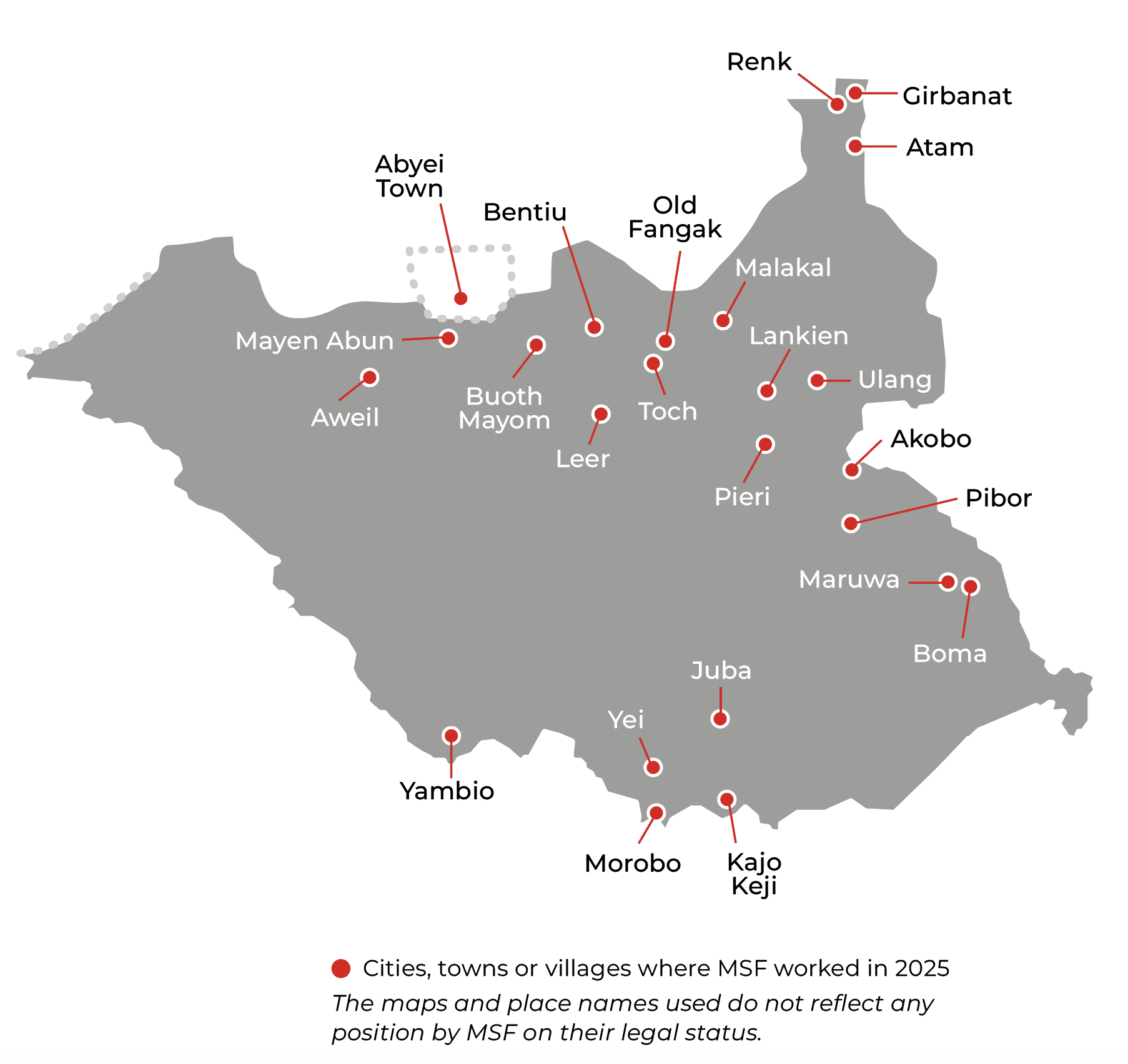
In 2025, in response to these escalating crises, MSF remained at the forefront of emergency and medical interventions across South Sudan, providing lifesaving healthcare, vaccinations, water and sanitation services, and distributions of essential relief items across seven states and two administrative areas. This included critical emergency support to refugees and returnees in Upper Nile state, particularly at key entry and transit points in Renk.
In collaboration with the Ministry of Health, MSF played a vital role in responding to outbreaks of cholera across key epicentres including Malakal, Bentiu, Aweil, Juba and Pibor. The cholera response further exposed the gaps in healthcare system service delivery, highlighting the urgent need for stronger emergency healthcare systems and improved coordination. Sustained investment in healthcare –including capacity-building for health workers – remains essential to ensuring a resilient and responsive healthcare system.
South Sudan remains an extremely high-risk environment for humanitarian workers. Attacks on health facilities have been noticeably increasing, with nine attacks on MSF staff and facilities taking place in 2025. Continued violence against both civilians and aid workers is severely constraining humanitarian access and jeopardising the continuity of essential healthcare services.
Our activities in 2025 —

outpatient consultations, including 115,683 children under five

patients hospitalised
patients treated for malaria
children with severe acute malnutrition admitted for treatment
children vaccinated against measles
maternal deliveries assisted, including emergency caesareans

individual mental health consultations

patients treated for cholera

surgical interventions
MSF's Impact
MSF has been providing essential services including basic healthcare, mental healthcare and specialised medical care to people in the region that is now South Sudan for more than 40 years. Our mobile teams also provide health assistance to displaced people and remote communities.
In addition to responding to emergencies and disease outbreaks, we also carry out preventive activities, such as vaccination campaigns and seasonal malaria chemoprevention, as well as distributing safe drinking water and essential relief items.