
Burkina Faso

In Burkina Faso, Médecins Sans Frontières (MSF) continued to support displaced people and host communities affected by the volatile security situation and a significant reduction in international aid.
Our activities in 2025 —

litres of chlorinated water distributed

outpatient consultations

malaria cases treated

individual mental health consultations
Ongoing insecurity forced our teams to suspend and reorganise some activities in Tougan, Sourou region. In other areas of the country, such as Soum, Tapoa, and Kuilsé, thousands of people living under blockade are left with little or no humanitarian assistance. Our teams also witnessed how some critical medical services, such as nutritional support for children, were reduced, or even completely terminated, following the withdrawal of international aid.
Despite these constraints, our teams maintained projects in seven regions, delivering a range of medical activities, including general, paediatric, maternal, and mental health care, as well as screening and treatment for malaria and malnutrition.
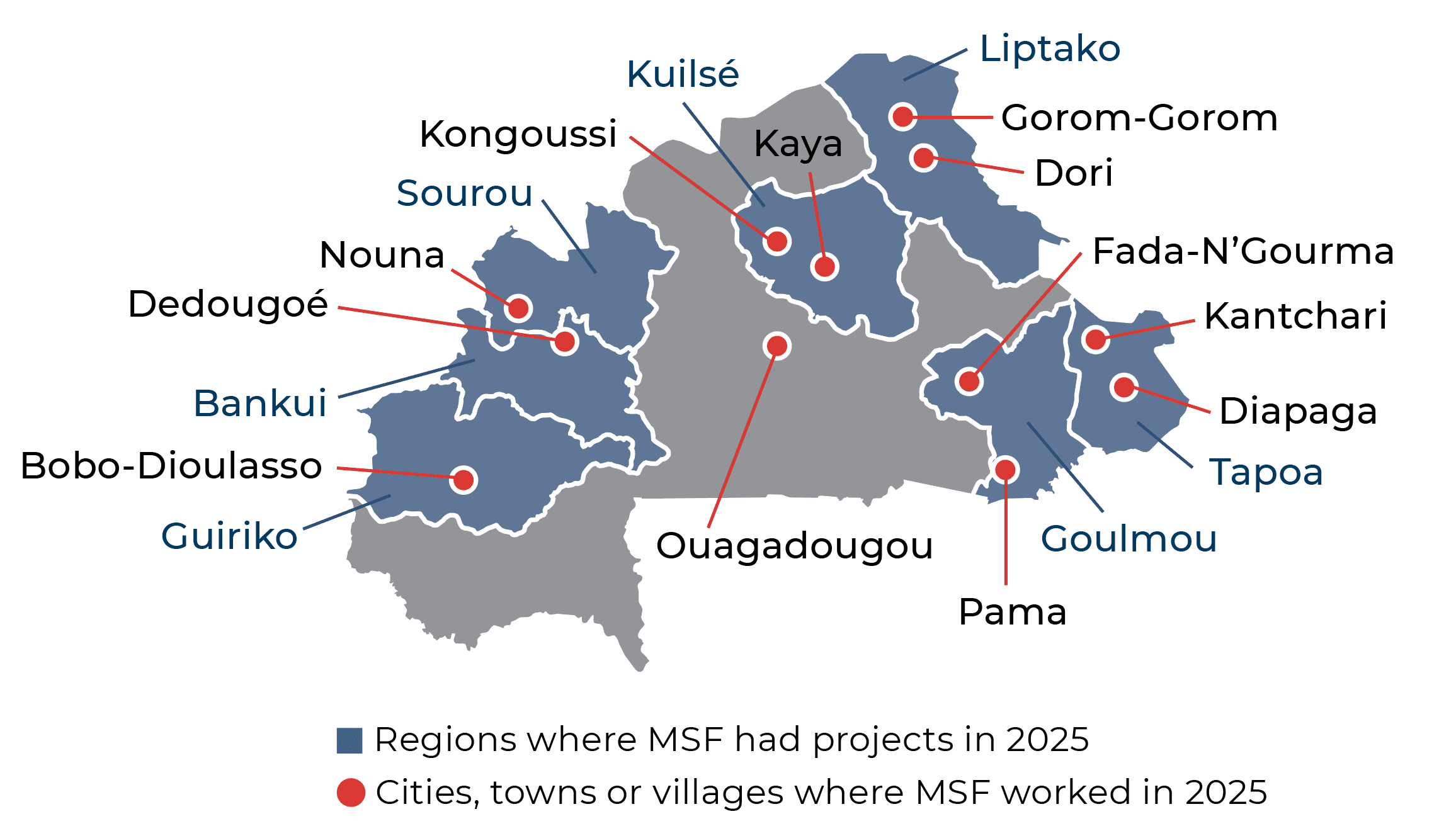
Our teams began working in Dédougou, in the northwest, to deliver improved care to people living with non-communicable diseases, in particular diabetes and hypertension. This included providing consultations, treatment, and referrals. We also sent mobile clinics to hard-to-reach areas, such as Djibasso, Bâ, and Bomborokuy.
MSF continued to train medical staff, and in 2025 our Academy for Healthcare celebrated the graduation of the first cohort of midwives in Bobo-Dioulasso. Other activities during the year included enhancing health infrastructure by building a neonatal unit in Kaya regional hospital, and improving water and sanitation in Gorom-Gorom by drilling a borehole and constructing a sterilisation room.
In addition, our teams launched multiple emergency responses to assist people displaced by insecurity in the east and northeast of the country. As well as providing lifesaving care, we supported routine vaccination campaigns, particularly against measles and polio.