
Displaced and forgotten: Families in northwest Syria face harsh winter conditions
In 1 click, help us spread this information :
In Syria, despite the end of the war, the population continues to suffer the consequences of fourteen years of conflict. In the regions of Homs, Hama, Aleppo, and Idlib, airstrikes and fighting have destroyed homes and essential infrastructure, forcing families to flee. Many have sought refuge in the mountains, and emergency shelters have become precarious and permanent living spaces where residents continue to survive.
While millions of people have been able to return home, thousands of displaced families remain in the camps, often due to a lack of financial resources to rebuild their lives. Um Ayman, 75, explains:
I returned home after the bombings and found my house razed to the ground." “I didn’t cry so much for my house as for my olive trees. I used to grow olives and oranges on my land, and it’s all gone.”
Their homes have been completely destroyed; basic services are lacking and livelihoods are scarce, making residents dependent on humanitarian aid, which has been steadily declining over the past two years.
Indeed, despite the enormous needs that remain in Syria, the country has seen a decrease in humanitarian funding. MSF urges humanitarian organizations to scale up their response, particularly for those who are still displaced and facing life-threatening conditions.
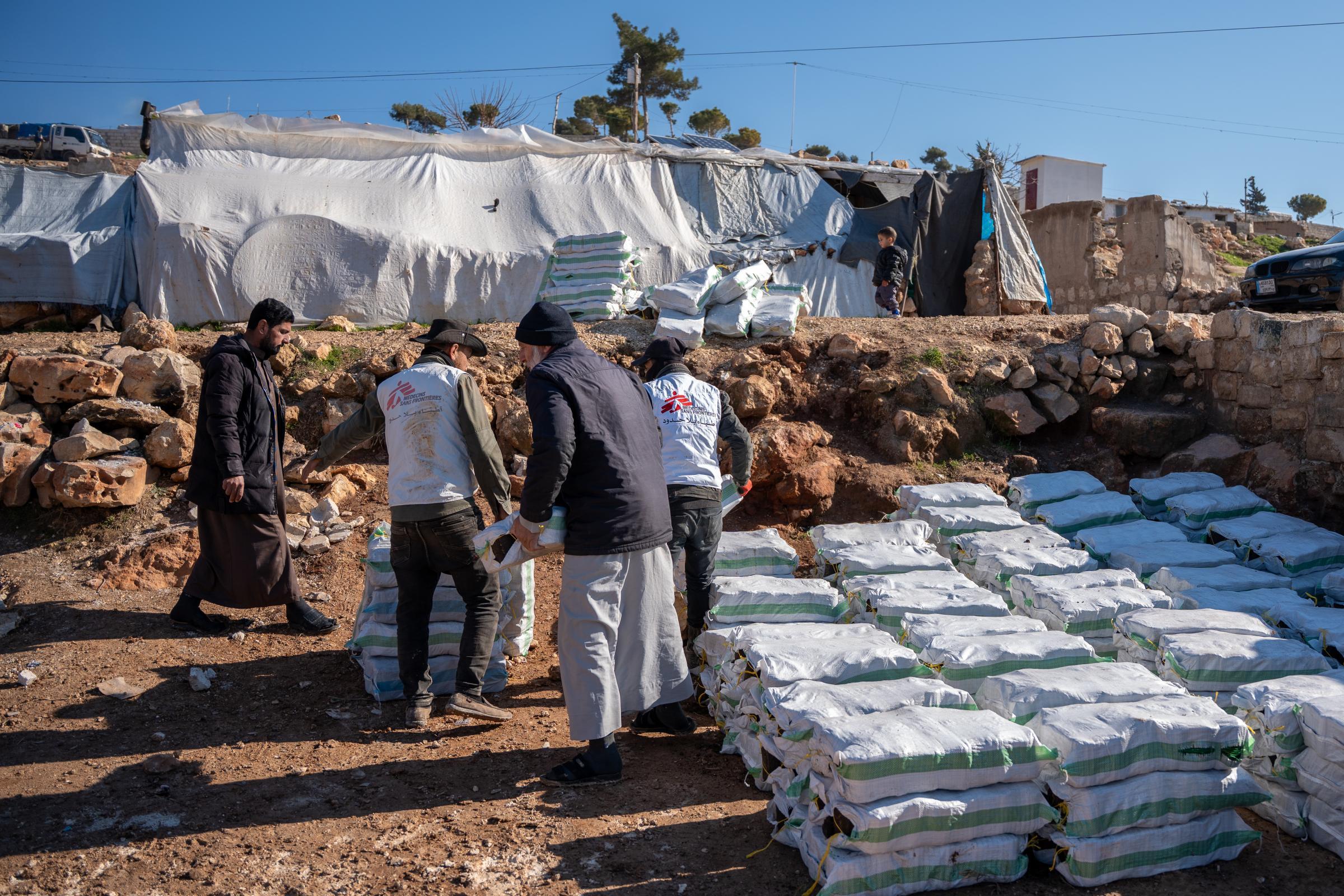
In Idlib province, Doctors Without Borders is providing support to displaced families. Between December and February, MSF teams distributed heating equipment (approximately 600 tons of charcoal) and plastic sheeting to 2,000 families in 21 camps. In addition, 150 families received tents in Armanaz. These distributions aim to help families cope with the winter months and reduce the immediate risks associated with exposure to the cold. However, the gap between needs and aid remains enormous.
In the Harim mountains and around the town of Salqin, 1,400 mattresses, 4,200 blankets, and hygiene and cooking kits were distributed to 700 families. In the region, more than 50 camps for displaced people still house thousands of families, many of whom live in makeshift shelters built from salvaged materials or bricks. Abu Musa, who lives in one of these camps, explains:
It has been a year and a few months since we received any aid from humanitarian organizations; after the liberation, no one provided any assistance to the people living in the camps here. “
The roofs are often unstable and offer little protection against snow, rain, and the bitter cold,” explains Um Ali, who lives with her three children in the Al Fardan camp:
When the snow started to fall, the plastic roof collapsed. We couldn’t clear the snow because we live in a mountainous region.”
The humanitarian needs are immense and constantly growing. Families lack access to sufficient food, healthcare, winter clothing, blankets, and medicine. Regarding access to healthcare, some camps have small clinics, but supplies are limited and services are fee-based, making essential care inaccessible to many.
Osama Joukhadar, MSF’s logistics manager, explains:
People here live in extremely precarious shelters. They are exposed to the cold, wind, and snow.” Every winter, families simply struggle to survive.