
West Bank: While the world looks elsewhere Palestinian land is disappearing
In 1 click, help us spread this information :
In the West Bank and the occupied Palestinian territories, the intensification of Israeli military operations, the increase in settler violence and the growing restrictions on movement are having a dramatic impact on access to essential health services for Palestinians.
In recent weeks, the dramatic escalation in the conflict between the US, Israel and Iran has added another layer of violence and fear across the Occupied Palestinian Territory. In this context, the medical activities of Médecins Sans Frontières (MSF) are severely hampered, preventing a large portion of the Palestinian population from accessing healthcare. The tightening of security and administrative restrictions imposed by the Israeli state undermines the ability of humanitarian organizations, including MSF, to meet the growing needs of the population.
“The military often comes at night, soldiers swarming the neighbourhood, breaking into our homes, destroying our property and arresting people en masse. Our houses are being seized and demolished,” says Sari Ahmad from Al Fakhiet in Masafer Yatta, in the Occupied Palestinian Territory (OPT). “And the settler attacks have grown more brutal and deadly. Most of them are armed nowadays and they shoot to kill.”
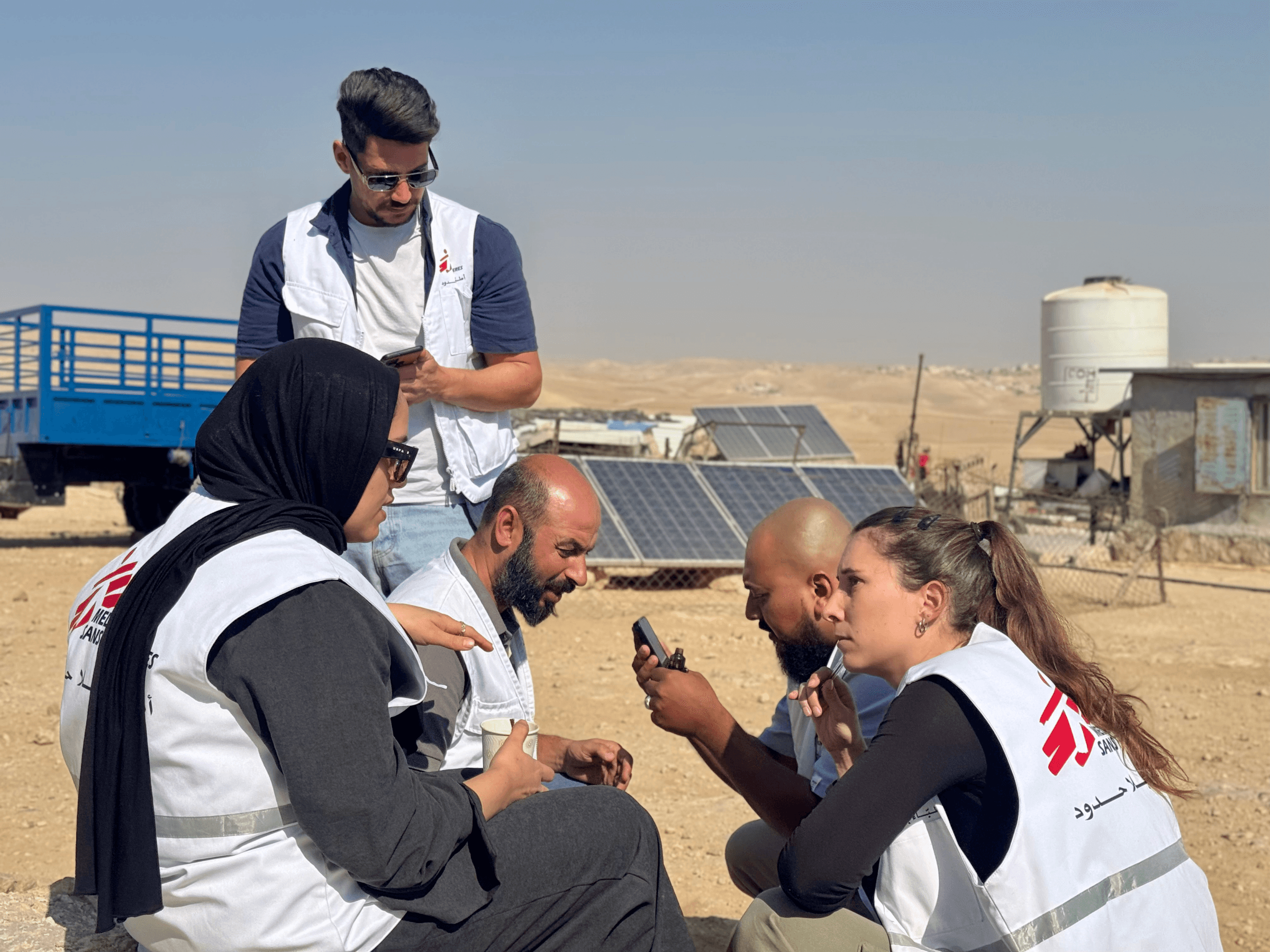
Sari, who suffers from diabetes, received treatment from Médecins Sans Frontières (MSF) teams until January, however, as violence and movement restrictions have increased, our teams can no longer access dozens of people in need in the area.
“When the sirens start, we gather in the hallway of our home, away from the windows. In the distance, explosions echo across the hills as interceptors strike projectiles,” says Yasmin Mohammad, MSF community health worker in Hebron. Unlike in Israeli towns and cities, where shelters and warning systems are widespread, most Palestinians in the West Bank have no access to shelters or protected spaces. When debris falls, families have little choice but to stay inside and hope.
“We feel the space in which we can live, move, and build our lives around is shrinking— while the world looks elsewhere,” says Yasmin Mohammad.
Violence by Israeli settlers has increased in several areas across the West Bank. Residents report settlers entering Palestinian villages or farmland while openly carrying weapons, as well as attacking Palestinians in their cars as they move from place to place.
Daily life in the West Bank is marked by violence and fear
Between 7 October 2023 and 7 March 2026 1,071 Palestinians, including 233 children, have been killed in the occupied West Bank, and Jerusalem, according to OHCHR. Eleven were killed by settlers this year alone. “It is shocking and deeply disturbing”, says Salam Yousef, an MSF staff member in the West Bank.
“They attack and kill people without consequences – it feels like there is no justice for us, like our lives don’t count,” says Yousef. “Last week, they [Israeli forces] shot a family of six who were driving home. Only two of the sons survived; they are orphans now – their family was killed in front of them; their brothers were seven and five years old.”
The widespread and multilayered violence has reshaped life for Palestinians – the sense of an existential threat captures a broader reality unfolding across the West Bank. “These developments feel like more than a series of isolated incidents, it is a slow but significant transformation, step by step Israeli forces and settlers are taking over,” says Salam Yousef. “It is frightening because we have no control and the world doesn’t seem to care about what happens to us.”
“Our lives and dreams are on hold”
“The psychological toll of this environment is immense,” says Elsa Salvatore, MSF psychotherapist in Nablus. “It’s not only about physical violence from settler attacks or what happens at checkpoints. In our sessions, people often speak about the humiliation they experience daily and the constant uncertainty. They become hyper-vigilant, unable to sleep, always expecting something bad to happen."
“Most people have stopped making plans. Many suffer from symptoms related to post-traumatic-stress-disorder (PTSD) - although PTSD is not correctly describing it, because they are not ‘post’ the traumatic experience, they are still in it, continuously experiencing trauma and uncertainty,” she says.
During this time, when violence, insecurity and restrictions on daily life are increasingly widespread across the West Bank, it is vital that people have access to healthcare. But in reality, it is just the opposite: access to medical care is blocked or severely obstructed.
In certain regions, like Masafer Yatta, south of Hebron, NGOs are blocked from providing essential humanitarian support, as large parts of the area are designated as a military zone and movement is heavily restricted by the Israeli forces. Consequently, we have had to reduce the number of our mobile clinics in the area from 17 to just 5 since September 2025; patients are being cut off from even the most basic medical services. “We feel abandoned and forgotten. There is no one coming to us anymore. When we get sick, we have no choice but to walk for miles. Sometimes we just stay and endure the pain,” says a resident from Masafer Yatta.
Greater needs need more access not less
Israel’s restrictive new rules threaten to drastically reduce this already insufficient aid. As MSF is one of 37 NGOs whose registration was not renewed by the Israeli authorities as of 1 March 2026, our international staff had to leave the OPT. While our Palestinian colleagues continue to provide healthcare, the future of our projects in the West Bank and the Gaza Strip is uncertain. In Nablus, Jenin and Tulkarem, our activities have also been significantly reduced due to both security concerns and new administrative obstacles imposed since 1 March.
“I’m scared and feel hopeless at the thought that MSF’s services could cease to exist,” says one of our mental health patients in Nablus.
Our teams do their best to provide remote psychosocial sessions online, but this does not provide the same support as in-person care. It especially doesn’t work for survivors of sexual violence, families of low socioeconomic level with telecommunication barriers and patients with chronic psychiatric conditions, such as psychosis.
Amid the ongoing humanitarian catastrophe in the OPT, MSF will continue to provide healthcare for as long as possible, doing as much as we can.