Humanitarian crisis in Yemen
After more than eleven years of conflict, Yemen remains mired in an unprecedented humanitarian crisis. More than a decade of war, marked by the collapse of the health system, the deteriorating economy, population displacement, the destruction of infrastructure, recurring epidemics, and restrictions on the delivery of essential goods, has had devastating consequences for the population.
Since September 2026, a new escalation has led to a rapid degradation of the humanitarian context in Yemen.
Last Updated: 21 October 2026
This latest escalation in Yemen is taking place in an already extremely worrying humanitarian context, aggravated by chronic underfunding of the humanitarian response. People in the country continue facing hardship, and access to health services, and the most basic services such as food or clean water are severely limited.
14,4 million people are in need of clean water, sanitation and hygiene assistance (WATSAN)
Since 2015, around 377,000 have died due to the conflict, and 22 million people need humanitarian assistance or support according to the UN.
Around 5,2 million people were displaced before the recent escalations according to the UNHCR. Since August, more than 217,000 people have been displaced in the country. Around 3,000 have fled Yemen to seek refuge in Djibouti.
An extremely fragile healthcare system
Yemen’s healthcare system is severely weakened after more than a decade of conflict and instability. Only 59% of health service in Yemen are fully functioning as of late 2026 considering that access to health was already challenging in many parts of Yemen before 2015.
The conflict damage on health infrastructures is not the main problem. The lack of human resources and supplies to operate, the difficulties for patients to afford and access care, and severe underfunding leave the country overwhelmed and underequipped to handle the growing humanitarian needs.
The WHO appealed for US$38.8 million in 2026 to deliver emergency health assistance to 10.5 million people. Health Cluster dashboard reported in June 26 that only 17% of funding requirement had been met at that point.
The impact of underfunding on primary healthcare services continues to cause preventable deaths and worsening health conditions, particularly among children and mothers, who are unable to access timely or adequate medical care.
Humanitarian organizations like MSF who are still operating in Yemen cannot absorb the ever growing humanitarian and medical needs. The support of existing facilities and opening of primary healthcare clinics are essential but not enough to provide the vital minimum medical services for the population.
The lack of routine vaccination coupled with the lack of primary and specialised care leaves people with high risks of contracting preventable diseases such as diphtheria, meningitis, polio and measles which are resurfacing in Yemen.
Supply disruptions are further limiting access to essential care in Yemen, especially in the north. Recent regional and local escalations have led to repeated flight and cargo cancellations, delaying critical medical supplies and increasing reliance on limited local markets, which is contributing to shortages of lifesaving items.
Key figures

PEOPLE NEED HUMANITARIAN ASSISTANCE¹

PEOPLE NEED WATSAN ASSISTANCE¹

PEOPLE ALREADY DISPLACED BEFORE THE RECENT ESCALATION¹
PEOPLE HAVE BEEN DISPLACED SINCE AUGUST 2026
Health indicators among the worst worldwide
Lack of access to essential care continues to fuel malnutrition and the spread of infectious diseases.
A crisis that can no longer be ignored
Yemen’s worsening humanitarian crisis demands urgent political and financial commitments by UN member states, donors, parties to the conflict and authorities in Yemen
The response to Yemen’s humanitarian crisis is severely underfunded. The humanitarian appeal (around 2,1 billion dollars) is only 22 per cent funded, leaving a gap of 1.72 billion dollar. In this context, an urgent and rapid scale-up of the humanitarian response is needed to address acute and growing needs.
Today, there are only approximately 13 international NGOs including MSF and ICRC still left operational in the northern parts of Yemen—an area where an estimated 75% (before the recent escalation) of the population lives and where humanitarian needs are high. As humanitarian actors withdraw, humanitarian needs do not disappear—the needs become harder to see, harder to reach, and harder to respond to.
Displaced people who are living in dire conditions urgently need food, water and sanitation services, shelter, and essential items.
Humanitarian organisations and the authorities must ensure and expand access to healthcare for the people affected by the crisis. Displacement, insecurity, and overstretched services are leaving many unable to reach urgently needed care. Critical humanitarian attention should be put on:
Health service delivery: responding to the growing needs due to more than a decade of conflict and a collapsing health system, including emergency, trauma, and referral needs linked to conflict.
Scale up nutrition treatment and prevention programs targeting acutely malnourished children, Pregnant and Breastfeeding Women and Girls (PBWG), and on availability and distribution of nutrition items.
Urgently support measles and other essential vaccination activities to reach all children in Yemen.
Urgently support cholera and acute watery diarrhoea preparedness + response with integrated Water, Sanitation and Hygiene support, surveillance, and emergency health services.
Protecting civilians, health facilities and humanitarian aid
In times of conflict, civilians and medical missions must be protected at all costs, and principled humanitarian assistance should be facilitated.
All parties to the conflict must uphold their obligations under international humanitarian law (IHL) by protecting civilians and civilian infrastructure and take all feasible measures to spare civilians and the medical mission from the effects of the hostilities.
All parties to the conflict – and actors with leverage over them - and Yemeni authorities must facilitate the provision of principled humanitarian assistance. In particular safe, rapid and unimpeded humanitarian access should be ensured, to enable operational humanitarian and medical actors to continue to safely deliver lifesaving assistance. Delays, diversions, interferences or blockades on essential medical cargos and staff movement by regional and/or Yemeni parties to the conflict hampers the quality and timely delivery of services.
MSF activities in Yemen
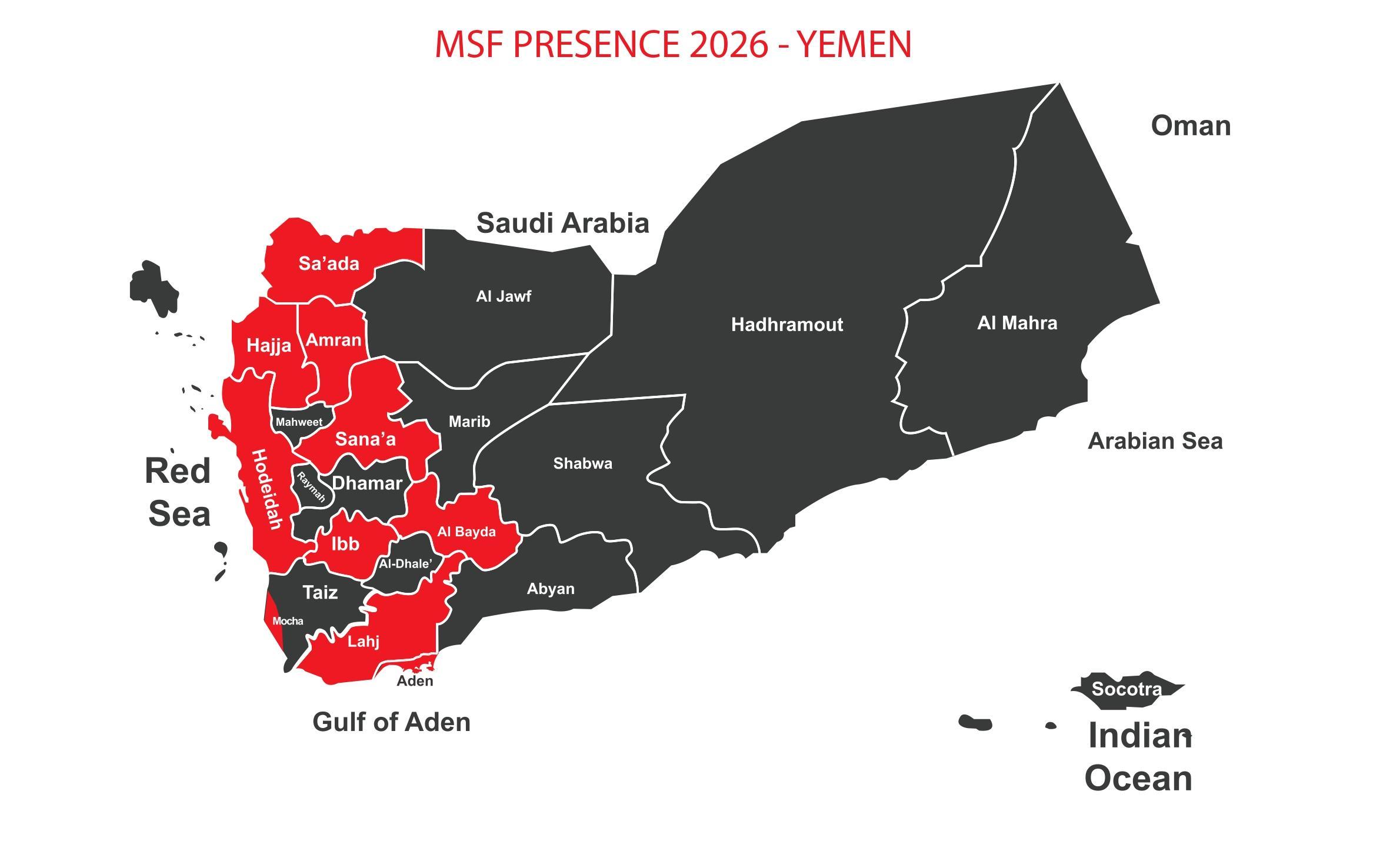
In several regions of the country, MSF teams are supporting hospitals and health centers to meet the medical needs of populations affected by the conflict.
MSF response in 2025:

OUTPATIENT COSULTATIONS

PATIENTS ADMITTED TO HOSPITAL

PEOPLE TREATED FOR CHOLERA

BIRTHS ASSISTED

CHILDREN ADMITTED TO INPATIENT FEEDING PROGRAMMES

PEOPLE TREATED FOR MEASLES

MALARIA CASES TREATED

INDIVIDUAL MENTAL HEALTH CONSULTATIONS
MSF response since the recent escalation
West and South of Yemen
Support to the paediatrics and maternity services at the Mocha General hospital:
- 651 patients (10 September to 11 October) at the emergency department
- 87 deliveries, including 37 c-sectionsSupport to primary healthcare center (PHCC) in Khokha:
- 130 to 160 consultations per day average
- 2,199 patients seen at triage
- 49 deliveriesSupport to primary healthcare center, emergency and maternity in Mafraq (reopened 12 October):
- 18 consultationsTrauma response: Emergency medical kits in 2 healthcare centers in Khokha and Mafraq, as well as in Dhubab’s healthcare centres. Four trauma kits sent to Taiz hospital. Capacity building activities in Ibn Khaldoun hospital in Lahj.
- Support to emergency department at Al-Joumhouria Hospital in Aden, between 12 September and 11 October:
- 70 injured patients (most of them arrived between 12 and 15 September)
- Trauma kits donated to support the mass casualty response. - MSF Aden project team, respond to the MCI by supporting triage organization and rapid needs/gaps evaluation and support as well as building capacities by current MCI training for HCW to be ready future events.
- Mobile clinics in Aden and Lahj governorates:
- 1,060 consultations since 15 September
North Yemen
- In Abs governate, MSF teams has treated 72 wounded patients between 17 and 23 August 2026, at the Abs General Hospital and have donated medical kits to the hospital.
- In Dhi As Sufal City, Ibb Governorate, MSF teams treated five wounded patients between 11 to 15 October following recent escalations in Taiz Governorate, given the project’s proximity to the area. The project activated its Mass Casualty Plan to receive up to 40 patients. MSF also supported the local general hospital with eight blood units, two trauma kits for 20 patients, and 50 body bags, while regular hospital activities continued.
- In Al Bayda Governorate, MSF sent two trauma kits for 20 patients in response to recent Mass casualty incidents. The authorities assigned one kit to Rada’a district and one to Al Bayda city. Further support planned for Rada’a by 10 October includes one mass casualty kit for 50 patients, one trauma kit for 20 patients, and staff training.
- In Al-Hudaydah Governorate, MSF donated trauma and surgical kits to hospitals in Hudaydah to support treatment for up to 200 patients.
By choosing to donate to the Emergency Fund, you enable our teams to act immediately wherever we deploy emergency relief, such as in Yemen.