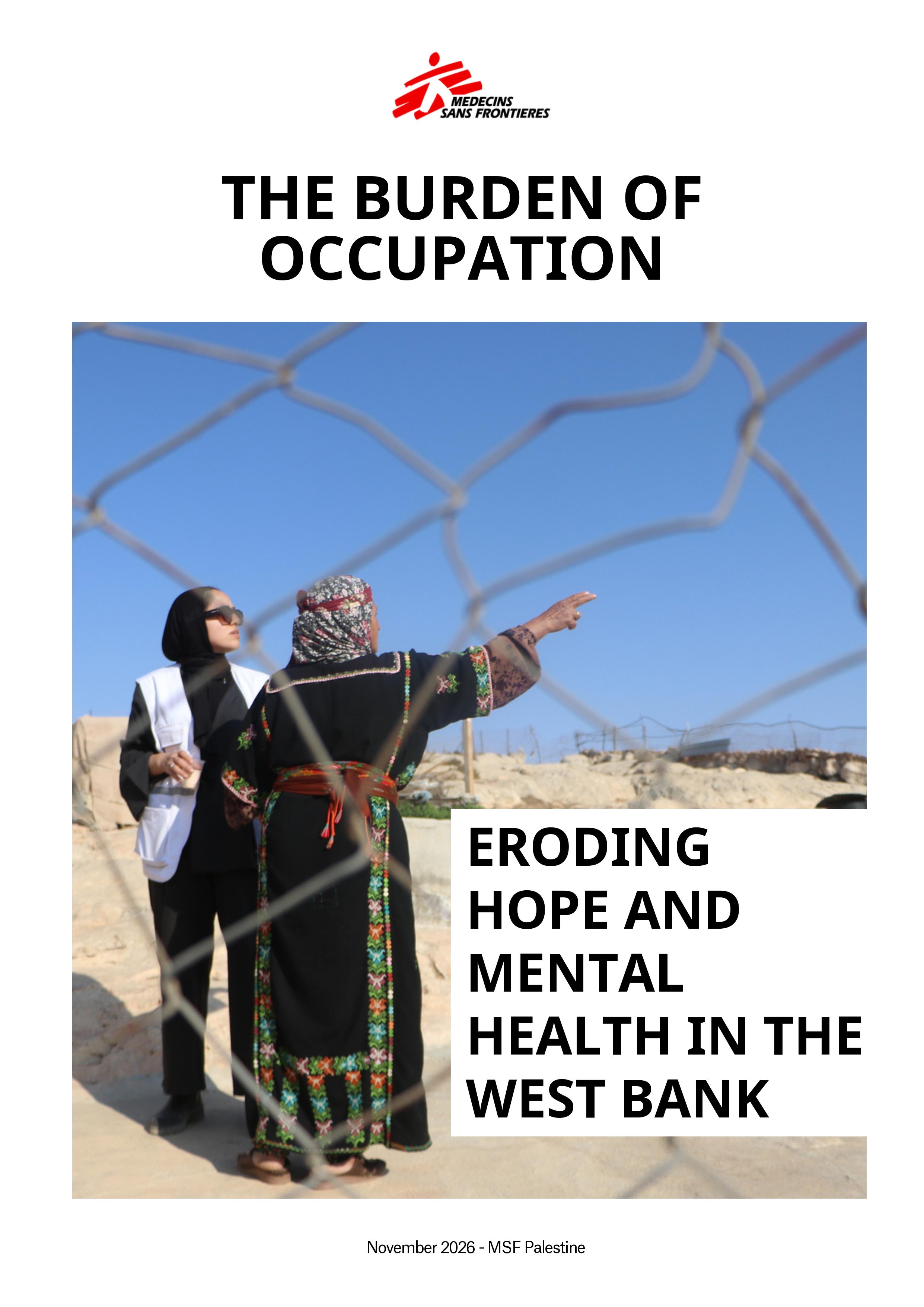
The burden of occupation is eroding people’s hope and mental health in the West Bank
Under embargo until 19 November 2026, 06.00 CET
At a critical moment for MSF’s presence in Palestine, this report brings together in-depth interviews with healthcare workers and patients and medical data collected between October 2022 and April 2026 to document the suffering, coping mechanisms, and unmet needs of Palestinians in the West Bank. Drawing on years of programme experience across different locations and communities, it identifies systemic factors, examines patterns of psychological distress, and frames patients' experiences within the broader reality of life under occupation.
Palestinians in the West Bank, Palestine, experience prolonged exposure and patterns of serious mental health issues, the consequences of the increasingly oppressive Israeli occupation, a new report from Médecins Sans Frontières (MSF) finds. Increased Israeli violence, and practices such as movement restrictions, settlement expansions, demolitions, and forced displacement across the West Bank are reaching extreme levels, and are part of Israel’s strategy to ethnically cleanse Palestinians from the occupied Palestinian territories, warns MSF. Israel must end all policies and practices which are driving Palestinians’ insecurity, fear, and psychological harm.
The report, The Burden of Occupation, brings together medical data collected between October 2022 and April 2026, alongside patients and staff testimonies from July 2026. The report reveals the profound impact of violence, fear, prolonged adversity, and instability on people’s daily lives. It also highlights how the continued oppression of Palestinians in the West Bank is shaping generations, leading to distress that reverberates through families and communities.
“What patients and MSF staff are facing in the West Bank reflects a wider pattern of systematic oppression across Palestine,” says Filipe Ribeiro, MSF Head of Mission for Palestine.
“Israel employs different mechanisms – from physical violence to land appropriation, from economic strangulation to social destruction – to dismantle Palestinian collective life,” says Ribeiro. “Whereas in Gaza this ‘logic of elimination’ has reached its most extreme form, ‘compressing’ people into ever-shrinking living spaces under inhumane conditions and relentless fire in the West Bank, Israel is replicating the pattern of destruction and annihilation, albeit on a different scale.”
“People in the West Bank have little choice but to live under relentless settler attacks, institutional violence, and permanent threat, or to leave,” adds Ribeiro.
In recent months, Israeli settlers’ attacks across the West Bank have reached extreme levels, with 15 settler attacks per day between 1 and 26 October, according to the UN Office for the Coordination of Humanitarian Affairs (OCHA), resulting in casualties or property damage. Our patients and staff in Hebron and Nablus have been directly affected by the violence, and are struggling to access basic services, including medical facilities, due to movement restrictions and insecurity.
“Nothing has really changed, except that the settlers have become more aggressive — they come more often, and my brother had his legs broken by settlers with a metal object,” says an MSF patient from Hebron. “We are afraid to go out.”
“Around midnight to about one or three in the morning we stay awake, and after three a.m. we get a little rest and feel that the hard part is somewhat over,” she says. “We never sleep at night — we stay afraid of them.”
Findings in the report underscore that mental health in the West Bank is best understood not as a series of isolated clinical problems, but as a pattern shaped by cumulative exposure to violence, restrictions, displacement, uncertainty, separation and loss. In this setting, distress often reflects not only acute shock, but prolonged exposure to conditions that erode predictability, autonomy, and hope.
Violence is the key driver of distress observed by MSF. It accounted for about 70 per cent of the overall reason which triggers patients seeking MSF mental health care in the West Bank, between October 2022 and April 2026.
According to our analysis, anxiety and depression-related symptoms are the most common mental health signs among MSF patients in the West Bank, representing about two-thirds of their reported mental health conditions. However, other symptoms observed by MSF mental health staff include trauma-related and psychosomatic-related issues.
People’s mental health needs in the occupied territory are rising, while access to care is shrinking. In January 2026, Israeli authorities did not renew MSF’s registration status and have since refused our international staff and supplies to enter Palestine; Israeli military coordination offices have also suspended communication with us. Without security guarantees, we have been forced to sharply reduce activities; in June, we closed all activities in Jenin and Tulkarem, while in Hebron and Nablus our teams had to significantly scale back medical care.
In October in Hebron, Israeli forces imposed a 10-day lockdown and siege on the area – amounting to a form of collective punishment – following the fatal shooting of two Israeli soldiers. Subsequent military raids, mass arrests, and demolitions displaced at least 3,300 Palestinians, according to the Hebron Municipality. It also forced our teams to freeze temporarily our regular activities, including mental health services, which prevented people from accessing healthcare and basic services.
This surge in mental health needs and violence is not an isolated event, but part of a long history of systemic oppression by Israel. In July 2024, the International Court of Justice found Israel’s continued presence in Palestine is unlawful, citing its prolonged occupation, settlement expansion, annexation practices, and discriminatory measures, and called for an end to the occupation and settlement. The Court further found that Israeli legislation and measures imposed on Palestinians breach the international prohibition of racial segregation and apartheid.
MSF urges international leaders and governments, including Israel’s allies, to use all political, diplomatic, economic and legal leverage to ensure Israel’s compliance with international law, including with its obligations as an occupying power. Israel needs to work towards ending its presence in the occupied Palestinian territory, and to ensure the rights of Palestinian people.