Antimicrobial Resistance Operational Research Training
AMR SORT IT Operational Research Training – Apply Now
The 2026 AMR SORT IT Operational Research Training is now open for applications. This hands-on, multi-module course will run from November 2026 to 2028, combining in-person sessions (Abidjan, Luxembourg) with online mentoring and webinars.
Designed to build practical operational research skills through a “learning by doing” approach, the course supports participants from concept development to publication and implementation.
Deadline to apply: 4 August 2026 (23:59 CET). This opportunity is open to internal MSF staff only, who are encouraged to apply and contribute to advancing evidence-based AMR action.
Building evidence with Operational Research
Antimicrobial resistance (AMR) is a growing serious threat to global public health associated with 4.95 million deaths, including 1.27 million attributable deaths in 2019. Projections estimate that AMR could translate into 169 million deaths, including 39.1 million attributable deaths, between 2025 and 2050. However, by providing better treatment for severe infections and improving access to antibiotics, 92 million of these deaths could be averted. Beyond bacterial resistance, viral, fungal, and protozoal AMR also significantly contribute to the global health burden. Despite the global recognition of the AMR crisis, the need in humanitarian contexts remains inadequately covered, including research agendas.
In this critical landscape, Médecins Sans Frontières (MSF, Doctors Without Borders) plays a key role by operating in some of the most underserved regions of the world. MSF focuses on the needs of the most vulnerable patients, including neonates, malnourished children, individuals living with advanced HIV, and those suffering from trauma and war-related injuries. Moreover, MSF has a unique capacity to conduct research in neglected contexts that would otherwise be inaccessible.
2026 AMR Operational Research Training
The MSF Luxembourg Operational Research Unit at OCB (LuxOR) runs since 2009 the SORT IT operational research training (Structured Operational Research Training Initiative), aiming to enhancing research capacity of MSF project staff, by combining mentorship by experienced researchers with a hands-on, ‘learning by doing’ approach. Given the current strategic relevance of AMR related OR, this has been identified as the focus thematic for the next edition of the training in 2026, to drive policy and practice changes in MSF through scientific analysis. Commitment is therefore required both from the applicant, to complete the course until the end, and from the project / mission / cell or department to dedicate resources to implement the recommendations emerging from your research’s analysis.
A total of 8 places are available for candidates from any OCs / Sections.
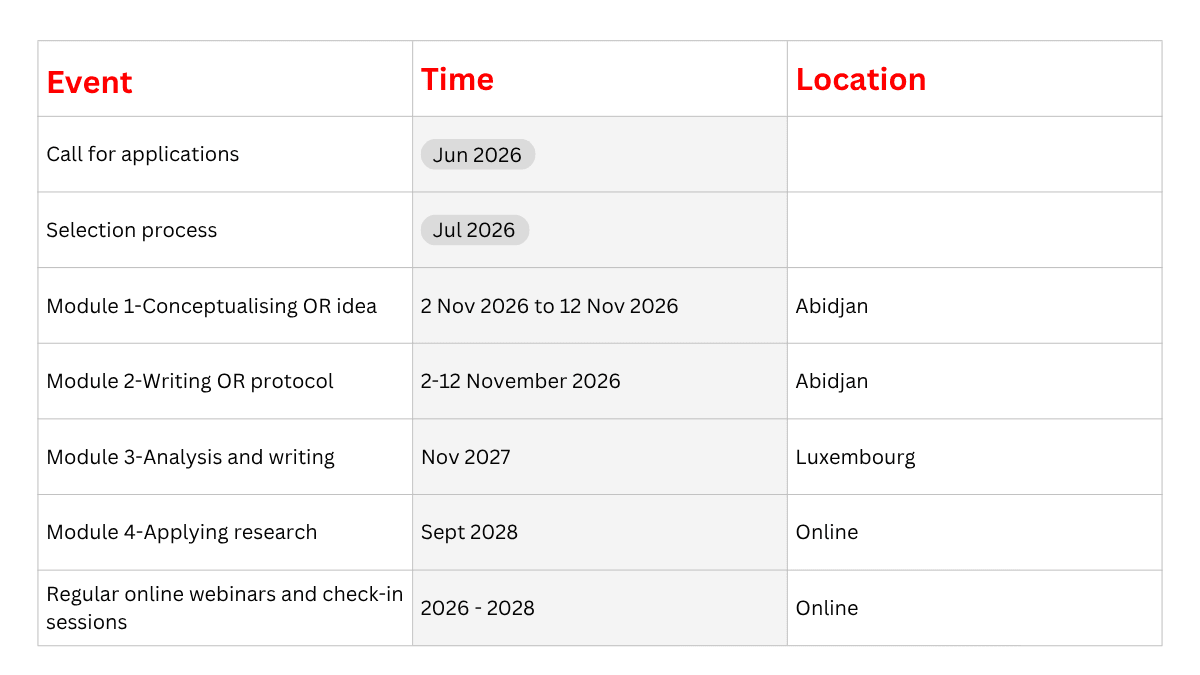
Preliminary chronogram
Who can apply?
All MSF staff from all operational centers, whether in the project or at headquarters, can apply to the AMR SORTIT. We believe diverse perspectives — across race, gender, sexual orientation, religion, age, and disability — enrich the learning experience, and we strongly encourage all to apply.
What backgrounds, skills and competency are needed?
The training is open to all backgrounds – medical, public health, epidemiology, health promotion, social sciences, logistics, analysis, advocacy, etc. We require an interest in and commitment to the AMR thematic, as well as some basic skills and competencies in research comparable to those of an early researcher. For example, holding a Master's with some methods courses in the curriculum; having participated in previous operational research initiatives or trainings; having worked as a researcher for studies or assessments.
Learning objectives
With this course, you will be able to:
Understand what operational research is and the process related to its deployment
Write a research protocol in all its components and submit to the MSF Ethical Review Board
Strengthen your research skills and competencies in performing a literature review, carrying on methodologies for data collection and analysis of data
Write a scientific paper
Outline operational recommendations based on your research findings with a dissemination and implementation strategy
Learn more about scientific evidence on climate, environment and health and how MSF can benefit from them
Apply now
Apply by 4th August 2026, 11.59 PM CET time on this link
AMR in MSF
MSF recognised AMR as a priority in 2015: an intersectional road map (2016-2020) was developed and a multidisciplinary Task Force, composed of medical experts, was created to guide AMR control in MSF. Since 2022, the AMR Platform has coordinated and led efforts to address AMR, providing a platform for the three key medical pillars: Infection Prevention and Control (IPC), Antimicrobial Stewardship (AMS), and Diagnosis and Surveillance (D&S), to coordinate their responses across all operational centres. A map of all MSF AMR projects and further information can be found at the AMR Platform SharePoint.
If you have any questions: please, reach out to operationalresearch@brussels.msf.org